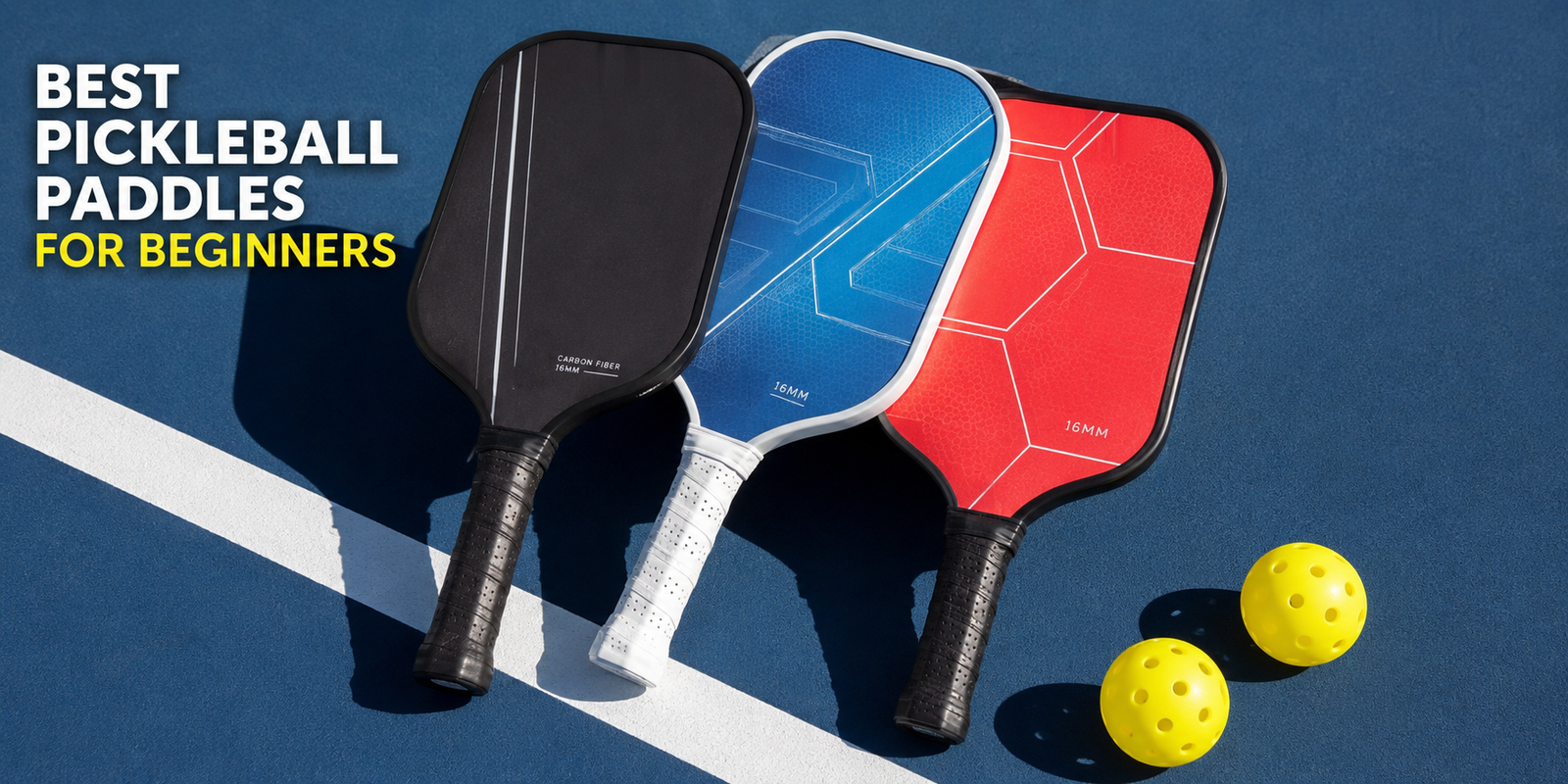
Best Pickleball Paddles for Beginners 2026: Top 5 Picks
Skip the guesswork. Here are the five best picks to get you started on the right foot in 2026.
What to Look for in a Beginner Pickleball Paddle
[IMAGE: pickleball paddle close-up texture]
Before diving into specific products, it’s worth understanding what separates a great beginner paddle from a mediocre one. The most important factor is control over power. New players benefit far more from a paddle that helps them place shots accurately than one that blasts the ball out of bounds. Look for a paddle with a polymer core — it’s forgiving, quiet, and widely regarded as the best starting material for recreational players.
Weight matters more than most beginners realize. A paddle in the 7.5–8.5 oz range is considered mid-weight and offers a solid balance between power and maneuverability. Anything heavier can cause arm fatigue or even elbow strain (commonly called “pickleball elbow”), while ultra-light paddles can feel flimsy and reduce your control at the net. Grip size is equally important — a grip that’s too small or too large will affect your swing mechanics from day one.
Finally, consider price and durability. You don’t need to spend $150+ as a beginner, but going too cheap (under $25) usually means a fiberglass or wood surface that won’t last and won’t help your game develop. The sweet spot for beginners is typically $40–$90. For more on how to evaluate paddle specs, check out this helpful breakdown from USA Pickleball’s equipment overview.
Top 5 Best Pickleball Paddles for Beginners 2026
[IMAGE: five pickleball paddles flat lay]
1. Selkirk Sport SLK Halo Control XL
[IMAGE: Selkirk SLK Halo Control XL pickleball paddle]
Selkirk is one of the most trusted names in pickleball, and the SLK Halo Control XL is their standout offering for beginners who want a taste of premium performance without paying pro-level prices. The elongated shape gives you extra reach at the net, and the polymer core keeps your shots dialed in during those early learning stages.
The Halo’s MaxSpin raw carbon fiber face is a significant upgrade over traditional fiberglass, helping beginners add a touch of spin without having mastered technique yet. It’s one of the few paddles in the sub-$90 range that genuinely feels like it punches above its weight class.
Key Specs
- Weight: 7.6–8.2 oz
- Surface: Raw carbon fiber (MaxSpin)
- Core: Polymer honeycomb
- Grip Size: 4.25″
- Price Range: ~$79–$89
Pros
- ✅ Excellent control for beginners and intermediate players
- ✅ Lightweight and maneuverable at the net
- ✅ Premium carbon fiber face at a mid-range price
Cons
- ❌ Elongated shape takes slight adjustment for some players
- ❌ Limited power for players who want aggressive baseline play
- ❌ Grip may feel thin for players with larger hands
Who It’s Best For: Beginners who want a quality paddle they won’t outgrow in 3 months — especially those who play at the net and value control over power.
2. Paddletek Bantam EX-L Pro
[IMAGE: Paddletek Bantam EX-L Pro pickleball paddle]
The Paddletek Bantam EX-L Pro has earned a loyal following among beginner-to-intermediate players for good reason. It delivers a large sweet spot and forgiving feel that makes inconsistent shots far more manageable — exactly what you need when you’re still developing your stroke mechanics.
Paddletek’s proprietary polymer core is among the quietest on the market, which is a bonus if you play at noise-restricted courts (a growing concern at community centers and HOAs). The textured surface adds a subtle grip to the ball, giving beginners a bit of natural spin without requiring advanced technique.
Key Specs
- Weight: 7.8–8.4 oz
- Surface: Fiberglass composite
- Core: Polymer honeycomb
- Grip Size: 4.25″
- Price Range: ~$70–$85
Pros
- ✅ Large sweet spot — very forgiving for beginners
- ✅ Extremely quiet — great for noise-sensitive communities
- ✅ Durable build quality that lasts for years
Cons
- ❌ Fiberglass surface doesn’t generate as much spin as carbon fiber
- ❌ Slightly heavier feel compared to ultralight options
- ❌ Design options are limited
Who It’s Best For: Beginners playing in HOA communities or noise-restricted facilities, or anyone who wants a reliable “set it and forget it” paddle.
3. Onix Graphite Z5
[IMAGE: Onix Graphite Z5 pickleball paddle]
If you’re looking for the best bang for your buck as a beginner, the Onix Graphite Z5 is the paddle that consistently tops beginner recommendation lists — and for good reason. It offers a graphite face and Nomex core combo that provides an excellent touch, a wide-body shape for maximum surface area, and a price point that’s hard to argue with.
The wide-body design gives you one of the largest hitting surfaces in its class, which translates to more forgiveness on off-center hits. The graphite face gives it a slightly livelier feel than fiberglass, and the paddle is approved for USA Pickleball sanctioned play — so you can take it to any official tournament or club event.
Key Specs
- Weight: 7.5–8.2 oz
- Surface: Graphite
- Core: Nomex honeycomb
- Grip Size: 4.0″–4.25″
- Price Range: ~$55–$70
Pros
- ✅ Wide-body shape offers maximum forgiveness
- ✅ Great value — quality well above its price point
- ✅ USAPA approved for sanctioned play
Cons
- ❌ Nomex core is louder than polymer alternatives
- ❌ Less spin potential than carbon fiber paddles
- ❌ May feel stiff for players who prefer a softer touch
Who It’s Best For: Budget-conscious beginners who want a reliable, proven paddle without spending a lot — also great as a spare or gift paddle.
4. HEAD Radical Elite
[IMAGE: HEAD Radical Elite pickleball paddle]
HEAD is best known for its dominance in tennis and badminton, and the Radical Elite brings that same engineering mindset to the pickleball court. This is an excellent choice for players transitioning from tennis who want a familiar feel with proper pickleball responsiveness. The paddle’s optimized sweet spot and comfort grip make it immediately playable out of the box.
The Radical Elite features a composite fiberglass hitting surface combined with a honeycomb polymer core. What sets it apart is HEAD’s ergo grip design, which reduces wrist fatigue during extended sessions — a common issue for beginners who don’t yet have the muscle conditioning for long games.
Key Specs
- Weight: 7.9–8.1 oz
- Surface: Fiberglass composite
- Core: Polymer honeycomb
- Grip Size: 4.25″
- Price Range: ~$60–$75
Pros
- ✅ Ergonomic grip reduces wrist and arm fatigue
- ✅ Familiar feel for former tennis players
- ✅ Consistent, predictable ball response
Cons
- ❌ Not as much spin generation as carbon fiber models
- ❌ Mid-range power — not ideal for power hitters
- ❌ Design aesthetics are more conservative
Who It’s Best For: Beginners coming from a tennis background, or anyone who plays long sessions and wants to minimize arm and wrist fatigue.
5. Engage Poach Advantage
[IMAGE: Engage Poach Advantage pickleball paddle]
The Engage Poach Advantage is the wildcard on this list — slightly pricier than the others, but beloved by beginner-to-intermediate players who want a paddle that can genuinely grow with their game. Engage’s proprietary ControlPro polymer skin provides a unique tacky feel that helps beginners apply spin and control placement more intuitively.
The paddle’s slightly elongated profile improves reach without sacrificing too much of the sweet spot width. It’s also noticeably quiet, making it suitable for noise-conscious communities. If you’re serious about improving quickly and don’t want to buy a second paddle in six months, this is a smart investment.
Key Specs
- Weight: 7.9–8.3 oz
- Surface: ControlPro polymer skin
- Core: Engage proprietary polymer
- Grip Size: 4.25″
- Price Range: ~$85–$100
Pros
- ✅ ControlPro surface makes spin more accessible for beginners
- ✅ Quiet play — great for noise-restricted venues
- ✅ Excellent longevity — a paddle you can grow into
Cons
- ❌ Higher price point than most beginner paddles
- ❌ Slightly heavier feel may not suit all players
- ❌ Less widely stocked than other brands
Who It’s Best For: Ambitious beginners who plan to play 3–4 times per week and want a paddle that will still serve them well at an intermediate level.
Beginner Pickleball Paddle Comparison Table
[IMAGE: pickleball gear comparison flat lay]
| Paddle | Weight | Surface | Core | Price Range | Best For |
|---|---|---|---|---|---|
| Selkirk SLK Halo Control XL | 7.6–8.2 oz | Raw Carbon Fiber | Polymer | $79–$89 | Control-focused beginners |
| Paddletek Bantam EX-L Pro | 7.8–8.4 oz | Fiberglass | Polymer | $70–$85 | Quiet-court players |
| Onix Graphite Z5 | 7.5–8.2 oz | Graphite | Nomex | $55–$70 | Budget-conscious beginners |
| HEAD Radical Elite | 7.9–8.1 oz | Fiberglass | Polymer | $60–$75 | Tennis crossover players |
| Engage Poach Advantage | 7.9–8.3 oz | ControlPro Polymer | Engage Polymer | $85–$100 | Ambitious, frequent beginners |
How to Choose the Right Beginner Pickleball Paddle for You
[IMAGE: player choosing pickleball paddle store]
How to Choose the Right Beginner Pickleball Paddle for You
The biggest mistake beginners make is prioritizing looks or brand name over fit and feel. Before you buy, ask yourself these key questions:
How often will I play? If you’re playing once a week casually, the Onix Graphite Z5 or HEAD Radical Elite offer excellent value without overinvesting. If you’re already hooked and plan to play multiple times a week, the Selkirk Halo or Engage Poach Advantage will serve you better long-term — you won’t need to upgrade in 6 months.
What sport am I coming from? Tennis players should strongly consider the HEAD Radical Elite for its familiar weight and grip feel. Ping pong or badminton players tend to adapt quickly to lighter paddles and may prefer the Selkirk Halo’s carbon fiber face for its spin responsiveness.
Where do I play? If your community center, HOA, or residential courts have noise restrictions, prioritize paddles with polymer cores — the Paddletek Bantam EX-L Pro and Engage Poach Advantage are the quietest on this list.
What’s your grip size? Measure from the middle crease of your palm to the tip of your ring finger. Under 4.25″ suggests a small grip (4.0″–4.125″); 4.25″–4.5″ suggests a standard grip. When in doubt, go smaller — you can always build up with overgrip tape, but you can’t shrink a grip that’s too large.
Do you have any arm or wrist concerns? If you’ve had tennis elbow or general arm pain, opt for a lighter paddle (7.5–7.8 oz) with a polymer core. The softer core absorbs more impact and dramatically reduces vibration on contact. The HEAD Radical Elite’s ergonomic grip is also specifically designed for this.
Most Frequently Asked Questions About Beginner Pickleball Paddles
What is the best pickleball paddle for a complete beginner?
The Onix Graphite Z5 is widely considered the best starting point for true beginners. It offers maximum forgiveness with its wide-body shape, solid graphite face for touch and control, and a price point ($55–$70) that makes it a low-risk first purchase. If you’re willing to spend slightly more and want a paddle that grows with your game, the Selkirk SLK Halo Control XL is the best step up.
How much should I spend on my first pickleball paddle?
Plan to spend between $50 and $90 for your first paddle. Below $40, you’ll typically find wood or basic aluminum paddles that are heavy, dead-feeling, and hard on your arm. Above $100 as a beginner usually means you’re paying for features (spin tech, edge weighting, specialized core layers) that won’t benefit you until you’ve developed more consistent technique. The sweet spot for most beginners is $55–$85.
What’s the difference between graphite, fiberglass, and carbon fiber paddle faces?
These are the three most common hitting surface materials, and they have meaningfully different feels:
- Fiberglass is the most forgiving and offers a “trampoline” effect that adds pop to your shots. It’s the most common surface on budget-to-mid-range paddles and is great for beginners who want added power.
- Graphite is stiffer and provides better touch and control. It’s lighter than fiberglass, which improves maneuverability. It’s an excellent all-around choice for beginners who want to develop placement skills.
- Raw carbon fiber (also called “toray” or “T700 carbon”) is the most advanced surface. Its slightly abrasive texture grabs the ball and generates spin more easily. It was once a pro-only feature; now it’s appearing in paddles like the Selkirk Halo at reasonable price points.
What grip size is right for me?
A quick way to measure: hold your dominant hand palm-up and measure from the middle crease of your palm to the tip of your ring finger.
- Under 4.25″: grip size 4.0″ or 4.125″
- 4.25″–4.5″: grip size 4.25″
- Over 4.5″: grip size 4.5″
When in between two sizes, choose the smaller one — you can always add overgrip tape to increase grip circumference by approximately 1/8″ per layer.
Is a heavier or lighter paddle better for beginners?
Mid-weight paddles in the 7.5–8.2 oz range are best for most beginners. Here’s the tradeoff:
- Heavier paddles (8.5 oz+) deliver more power with less effort but cause arm fatigue faster and put more strain on your elbow and shoulder during extended play.
- Lighter paddles (under 7.5 oz) are extremely maneuverable and easy on the arm, but require more strength and technique to generate consistent shots, and can feel “whippy” or unstable.
Unless you have specific arm issues that require an ultralight paddle, stick to the 7.5–8.2 oz range as a beginner.
Can I use a pickleball paddle that’s not approved by USA Pickleball (USAPA)?
Yes — for recreational play, any paddle works. However, if you plan to compete in sanctioned tournaments or organized club leagues, your paddle must appear on the USA Pickleball approved equipment list. All five paddles on this list are USAPA-approved, so you won’t need to worry about that restriction as you progress.
How long does a beginner pickleball paddle last?
A quality paddle in the $50–$100 range will typically last 1–3 years with regular recreational play (2–3 times per week). Signs your paddle may be worn out include a dead or hollow sound on contact, visible surface delamination, or a cracked edge guard. Budget paddles (under $40) often last only a few months before the surface degrades and loses its feel. Storing your paddle away from extreme heat (car trunks in summer) significantly extends its lifespan.
Should I buy a paddle set or just one paddle?
If you’re introducing a household or group to pickleball, sets can offer excellent value — you can often get two to four beginner-quality paddles plus balls for the price of one or two individual paddles. However, the paddles included in sets are usually basic fiberglass or composite models without the performance features of the individual paddles reviewed above. If you’re serious about improving, buy one quality individual paddle and use inexpensive loaner or set paddles for friends who are just trying the sport.
What’s the difference between a standard and elongated paddle shape?
- Standard/wide-body paddles (like the Onix Graphite Z5) have a wider hitting area and larger sweet spot, making them more forgiving on off-center shots. Most beginners find these easier to control.
- Elongated paddles (like the Selkirk SLK Halo Control XL) are taller and narrower, providing extra reach at the net and more leverage for spin and power, but with a slightly smaller sweet spot. They’re best for beginners who have some athletic background and pick up hand-eye coordination quickly.
When in doubt, start with a standard or wide-body shape. You can always move to an elongated paddle once you’ve developed more consistent shot placement.
Final Verdict
There’s no single “perfect” beginner paddle — but there is a perfect paddle for you, based on how often you’ll play, what sport you’re coming from, and what feel you prefer.
If you want our single top recommendation for 2026, it’s the Selkirk SLK Halo Control XL. It delivers genuine performance at an accessible price, it won’t hold your game back as you improve, and the carbon fiber face gives you a tactile advantage that basic paddles simply can’t match. It’s the paddle most likely to stay in your bag for years, not months.
For pure budget value, the Onix Graphite Z5 remains the benchmark. For former tennis players, the HEAD Radical Elite is the most natural transition. And if you’re committed to the sport from day one, the Engage Poach Advantage is the long-game investment worth making.
Whatever you choose — get out on the court. Pickleball is one of the fastest-growing sports in the country for a reason, and no review can substitute for the first time you hear a perfectly struck dink land in the kitchen. Happy playing.
Excelent infirmation thanks
Muy interesante la información gracias