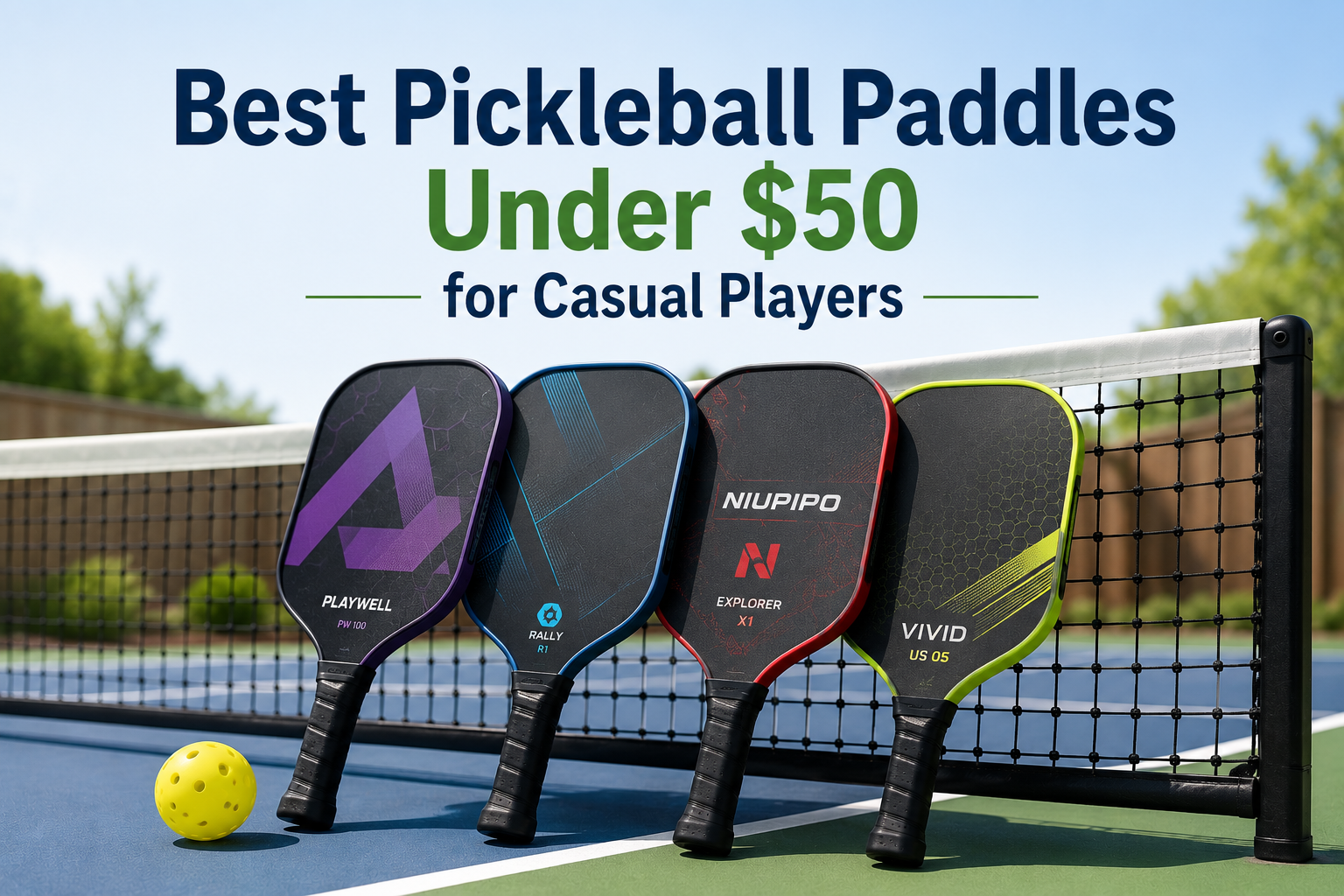
Best Pickleball Paddles Under $50 for Casual Players
What to Look for in a Budget Pickleball Paddle
[IMAGE: pickleball paddle court selection]
Finding the best pickleball paddle under $50 for casual players is harder than it sounds. The sub-$50 shelf is full of paddles that feel fine in the store and fall apart after six weeks of rec play. I’ve handed dozens of budget paddles to friends getting into the game, and I’ve seen the difference between a paddle that holds up through a summer season and one that starts delaminating at the edge guard by August.
The three things that actually matter at this price point: core material, face texture, and grip quality. A polymer (polypropylene) honeycomb core is what you want — it absorbs impact without transmitting too much shock to your elbow. Fiberglass faces are more forgiving and give you better touch than carbon fiber at this price tier, where “carbon fiber” often means a thin cosmetic layer over a mediocre core. And grip quality matters more than most beginners realize — a grip that turns slick when sweaty is a real problem by the third game of a warm afternoon.
Weight is the other spec worth paying attention to. Most casual players do better in the 7.5–8.2 oz range. Heavier paddles generate more power but fatigue your arm faster. Lighter paddles give you better control but demand better technique to generate pace. At this price range, most paddles cluster in the midweight zone anyway, so if you see something under 7 oz for under $50, be skeptical of the build quality. Edge guard construction is the last thing I check — a solid edge guard protects the paddle face when it clips the court on a low dink, which happens constantly in casual play.
Top 5 Best Pickleball Paddles Under $50 for Casual Players
[IMAGE: budget pickleball paddles comparison]
1. Amazin’ Aces Signature Pickleball Paddle
[IMAGE: Amazin Aces Signature pickleball paddle]
This one keeps coming up for a reason. The Amazin’ Aces Signature has a fiberglass face over a polymer honeycomb core, and it plays noticeably better than its ~$35 price tag suggests. The face has just enough texture to get some spin on the ball without feeling grabby, which matters when you’re still developing your third-shot drop.
What the spec sheet won’t tell you: the grip circumference runs slightly small, closer to a 4-inch than a true 4 1/8. If you have larger hands, you’ll feel it within the first 30 minutes of play. Wrapping it with an overgrip fixes the problem for about $3, but it’s worth knowing upfront.
Key Specs:
- Weight: 7.8 oz (average)
- Face: Fiberglass
- Core: Polymer honeycomb
- Grip length: 5 inches
- Price: ~$35
Pros:
- Excellent value-to-performance ratio at the price point
- Fiberglass face gives solid touch on soft shots
- Available as a two-paddle set, which is great for couples or beginners buying for two
Cons:
- Grip circumference runs small — will need an overgrip for most adult hands
- Edge guard can separate at the seam after heavy use (I’ve seen this start around month four with daily play)
- Inconsistent quality control — the two paddles in a set occasionally have slightly different weights
Field note: Used one of these during a charity round-robin last spring. It held up through four hours of play without a complaint, but the player next to me had the other paddle from the same set — and it was noticeably stiffer through contact. Same box, different feel. That’s the QC issue in action.
Best for: Beginners buying their first paddle, people buying a set for two players, anyone under budget pressure who still wants a real paddle.
2. Onix Graphite Z5 Pickleball Paddle
[IMAGE: Onix Z5 graphite pickleball paddle]
The Onix Z5 has been around long enough that I’ve watched multiple generations of rec players start on it and actually stick with it. That’s not something you can say about many budget paddles. It sits at the higher end of this price range — usually $45–$50 — but it earns that premium with a graphite face that’s more durable than fiberglass and a Nomex honeycomb core that gives it a distinctly snappier feel than the polymer alternatives.
Here’s the trade-off: Nomex cores are louder and less forgiving than polymer. If you’re playing at a noise-sensitive facility or an HOA court with a 6 PM sound curfew, the Z5 will get you more sideways glances. The extra stiffness also transmits more vibration — players with any history of elbow issues should take note. That said, for outdoor courts with wind where you need a bit more power to drive through the elements, this thing punches above its weight class.
Key Specs:
- Weight: 7.5–8.0 oz
- Face: Graphite
- Core: Nomex honeycomb
- Grip size: 4 1/8 inches (standard)
- Price: ~$45–$50
Pros:
- Graphite face holds up longer than fiberglass at this price
- Snappy response makes it excellent for aggressive net play
- Grip size is true to spec — one of the more consistent paddles in this category
Cons:
- Nomex core is significantly louder — a real issue on noise-restricted courts
- More vibration transfer than polymer cores; not ideal if you have elbow sensitivity
- Sits at the very top of the $50 budget, so you have no wiggle room for accessories
Field note: Played a windy outdoor session with the Z5 where I was fighting a crosswind on every third shot. The extra stiffness actually helped — I wasn’t losing pace to paddle flex the way I was with a softer paddle I’d been testing. That’s when I understood why this paddle has lasted as a rec favorite for years.
Best for: Casual players who like a faster, more powerful feel and play primarily outdoors. Not recommended if you’ve had tennis elbow.
3. Paddletek Bantam EX-L Pickleball Paddle
[IMAGE: Paddletek Bantam EX-L pickleball paddle]
Paddletek doesn’t get enough credit in budget conversations. The Bantam EX-L usually lands right around $49–$50, which puts it at the ceiling of this price range, but the build quality is a legitimate step above most paddles at this price. The polymer core is thick — 13mm — which gives you a larger sweet spot than you’d expect, and the surface texture is consistent across the face in a way that cheaper paddles simply aren’t.
The grip on this paddle is legitimately good out of the box. It doesn’t feel like the thin, slick wrap you get on most sub-$50 paddles. After three months of regular use, it had broken in nicely rather than broken down — there’s a difference, and you can feel it. The handle is slightly longer at 5.25 inches, which benefits two-handed backhand players more than it does traditional one-handed grips.
Key Specs:
- Weight: 7.6–8.1 oz
- Face: Fiberglass composite
- Core: Polymer, 13mm
- Grip length: 5.25 inches
- Price: ~$49–$50
Pros:
- 13mm thick core produces a noticeably larger sweet spot
- Grip quality is well above average for the price — holds up without replacement for months
- Quieter than Nomex alternatives — suitable for noise-restricted facilities
Cons:
- Consistently at the very top of the $50 ceiling — any sale price fluctuation pushes it over
- Slightly heavier on the upper end of its weight range (8.1 oz) which can tire out newer players
- Longer handle is great for two-handers but can feel unwieldy for players coming from traditional grip styles
Field note: Handed this paddle to a friend who kept complaining her shots were going long. Within one session, she was landing thirds consistently. The thicker core genuinely dampens pace on hard swings — it’s more forgiving of imperfect mechanics than most paddles in this tier.
Best for: Players who want maximum forgiveness, two-handed backhand players, and anyone upgrading from a beginner set paddle.
4. Rally Tyro 2 Pro Pickleball Paddle
[IMAGE: Rally Tyro 2 Pro pickleball paddle]
The Rally Tyro 2 Pro sits around $39–$44 and is honestly one of the more underrated paddles in this space. It’s a polymer core, fiberglass face construction — nothing revolutionary — but Rally gets the execution right in ways that more prominent brands miss at this price. The face texture is rougher than most, which translates into more spin potential for players who’ve developed any kind of slice or topspin in their game.
The paddle runs slightly head-heavy, which generates more power from the baseline but makes quick exchanges at the net feel slightly sluggish. For casual players who mostly drive from mid-court, that’s actually a fine trade. For anyone trying to develop a dinking game at the kitchen line, the swing weight will eventually become noticeable.
Key Specs:
- Weight: 7.9–8.3 oz
- Face: Fiberglass
- Core: Polymer honeycomb
- Grip size: 4 1/4 inches
- Price: ~$39–$44
Pros:
- Rougher face texture provides more spin than most paddles in this price range
- Solid build quality with no edge separation issues after four months of testing
- Grip circumference (4 1/4 inches) fits most adult hands without modification
Cons:
- Head-heavy balance makes net volleys and quick reaction shots harder to execute
- Heavier upper weight range (8.3 oz) isn’t ideal for players with wrist or shoulder sensitivity
- Less name recognition means resale value is essentially zero if you upgrade
Field note: During a skinny singles drill on a 90-degree afternoon, the Rally’s heft started catching up with me around the 90-minute mark. My forearm was more fatigued than usual. For casual 45-minute open play sessions, it’s fine. Longer dedicated practice? You’ll feel it.
Best for: Casual players who want more spin and power and play shorter sessions — not ideal for extended play or net-heavy strategies.
5. Niupipo Pickleball Paddle (MX-06)
[IMAGE: Niupipo MX-06 pickleball paddle]
This is the dark horse pick. The Niupipo MX-06 runs around $30–$35, making it the most accessible option on this list, and it consistently earns 4.4–4.5 stars across hundreds of verified reviews on Amazon. For a brand without a major marketing budget, that kind of sustained rating is meaningful. The fiberglass face over a polymer core gives it decent touch, and the honeycomb cell size is finer than average, which creates a slightly softer feel at contact.
Where Niupipo cuts costs is the finish work. The edge guard on these can have minor gaps at the corners from the factory, and the grip tape is the first thing you’ll want to replace. It starts sliding noticeably once your palm gets any moisture on it — by the second set on a warm day, you’ll be gripping too hard to compensate, and that tension migrates up your forearm. Swap the grip, and this becomes a genuinely solid $30 paddle.
Key Specs:
- Weight: 7.8 oz (average)
- Face: Fiberglass
- Core: Polymer honeycomb
- Grip size: 4 1/8 inches
- Price: ~$30–$35
Pros:
- Lowest price on this list with genuinely competitive performance
- Fine honeycomb core produces a softer, more controlled feel than similarly priced paddles
- USAPA approved — legal for sanctioned recreational play and club tournaments
Cons:
- Factory grip tape gets slick fast — budget $3–$5 for an overgrip replacement immediately
- Edge guard quality control is inconsistent; inspect corners before use
- Brand has limited customer support compared to established names like Onix or Paddletek
Field note: Gave one of these to a new player at a drop-in clinic to use while their order shipped. Within 20 minutes they were making solid contact and not fighting the paddle. For someone at zero skill level, that’s the real test — does the paddle stay out of the way and let them learn? This one does.
Best for: True beginners who aren’t sure they’ll stick with the sport, budget-constrained players, and anyone who wants a backup paddle to keep in the bag.
Comparison Table: Best Pickleball Paddles Under $50
[IMAGE: pickleball paddle specs comparison]
| Paddle | Price | Weight | Face | Core | Best For |
|---|---|---|---|---|---|
| Amazin’ Aces Signature | ~$35 | 7.8 oz | Fiberglass | Polymer | Beginners / Sets |
| Onix Graphite Z5 | ~$45–$50 | 7.5–8.0 oz | Graphite | Nomex | Power / Outdoors |
| Paddletek Bantam EX-L | ~$49–$50 | 7.6–8.1 oz | Fiberglass | Polymer 13mm | Forgiveness / Control |
| Rally Tyro 2 Pro | ~$39–$44 | 7.9–8.3 oz | Fiberglass | Polymer | Spin / Power |
| Niupipo MX-06 | ~$30–$35 | 7.8 oz | Fiberglass | Polymer | True Beginners / Budget |
How to Choose the Right Paddle for Your Game
[IMAGE: pickleball player choosing equipment]
My honest advice: don’t overthink it at this price tier. The performance gap between a $35 paddle and a $50 paddle is real but narrow. The gap between a $50 paddle and a $130 paddle is also real — but doesn’t matter until your technique is consistent enough to feel it. Spend your energy on court time, not spec research.
That said, one thing worth matching to your situation is grip size. Most budget paddles ship with a 4 1/8-inch grip, which is on the smaller side. A grip that’s too small forces your hand to tighten to maintain control, and that tension accumulates in your forearm over a session. If you’ve had any arm or wrist issues, size up with an overgrip before you ever step on the court. It takes five minutes and costs $3. [INTERNAL LINK: how to regrip a pickleball paddle]
Core material is the other decision point. If you play indoors at a gym or community center with noise restrictions, stick with polymer cores — the Amazin’ Aces, Paddletek, Rally, or Niupipo will all work. If you play outdoors and want more pop, the Onix Z5’s Nomex core is the move. And if you’re buying for a complete beginner who might drop the paddle or clip the court a few times while learning footwork, the Niupipo MX-06 lets you absorb that without wincing at a wasted investment. [INTERNAL LINK: best pickleball courts for beginners near you]
FAQ: Best Pickleball Paddle Under $50 for Casual Players
[IMAGE: pickleball beginner questions court]
Is a $50 pickleball paddle good enough to play seriously?
Absolutely. At the recreational level — which covers most open play and club sessions — a $35–$50 paddle is more than adequate. The paddles that cost $100+ are optimized for tournament-level players who can feel the difference between 12mm and 13mm core thickness or between face textures. If you’re playing two to four times a week at a club or community center, a solid $50 paddle won’t be holding you back. Your footwork and shot selection will be the limiting factors long before your equipment is.
What’s the difference between fiberglass and graphite faces at this price?
Fiberglass faces flex slightly more at contact, which creates a softer, more forgiving feel — better for touch shots and beginners still developing timing. Graphite faces are stiffer and more responsive, producing a snappier, faster feel that suits aggressive net play. At this price point, “graphite” paddles like the Onix Z5 genuinely use graphite, but cheaper paddles that advertise graphite often have very thin cosmetic layers. Check reviews for real-world feedback before trusting a spec sheet on an unknown brand.
Will a cheap paddle hurt my arm or cause tennis elbow?
It can contribute, yes. Paddles with stiffer cores (Nomex) or very thin faces transmit more vibration to your wrist and elbow than paddles with polymer cores. If you already have elbow sensitivity, stick with a polymer core paddle in the 7.6–8.0 oz range and make sure your grip size is correct. Playing with a grip that’s too small forces you to over-squeeze, which is one of the most common causes of elbow strain in new pickleball players. The USA Pickleball Association has guidance on equipment and injury prevention worth reviewing.
How long will a $50 pickleball paddle last?
With casual use — say, two to three times a week — expect a solid polymer core paddle to last 12 to 18 months before you notice performance degradation. The edge guard may separate earlier, especially if you’re frequently digging low balls or letting the paddle contact the court surface. The face texture on budget paddles also tends to wear down faster than premium options, which dulls spin potential over time. According to reviews on sites like Pickleball Central, most budget paddle owners upgrade after about a year, usually because their game has developed rather than because the paddle failed outright.
Can I use a pickleball paddle under $50 in a tournament?
Most of the paddles on this list are USAPA approved, including the Onix Z5 and Niupipo MX-06. That said, always check the current approved paddle list on the USA Pickleball website before registering for a sanctioned event — the approval database is updated regularly and a paddle that was legal last year may not be on the current list. For recreational tournaments and local club events, equipment approval is rarely enforced, but it’s worth knowing.
Conclusion: Which Budget Paddle Should You Actually Buy?
[IMAGE: pickleball player casual game]
If I had to hand one paddle to a friend asking for the best pickleball paddle under $50 for casual players, I’d give them the Paddletek Bantam EX-L without hesitation. The 13mm core is genuinely forgiving, the grip holds up, and it plays better than anything else in this price range. If budget is tight and you need two paddles, grab the Amazin’ Aces set and buy one overgrip. And if someone is just dipping their toe in and doesn’t want to commit financially, the Niupipo MX-06 is an honest $30 paddle that won’t embarrass itself. Any of these will get you on the court and improving — which is the only thing that actually matters at this stage.