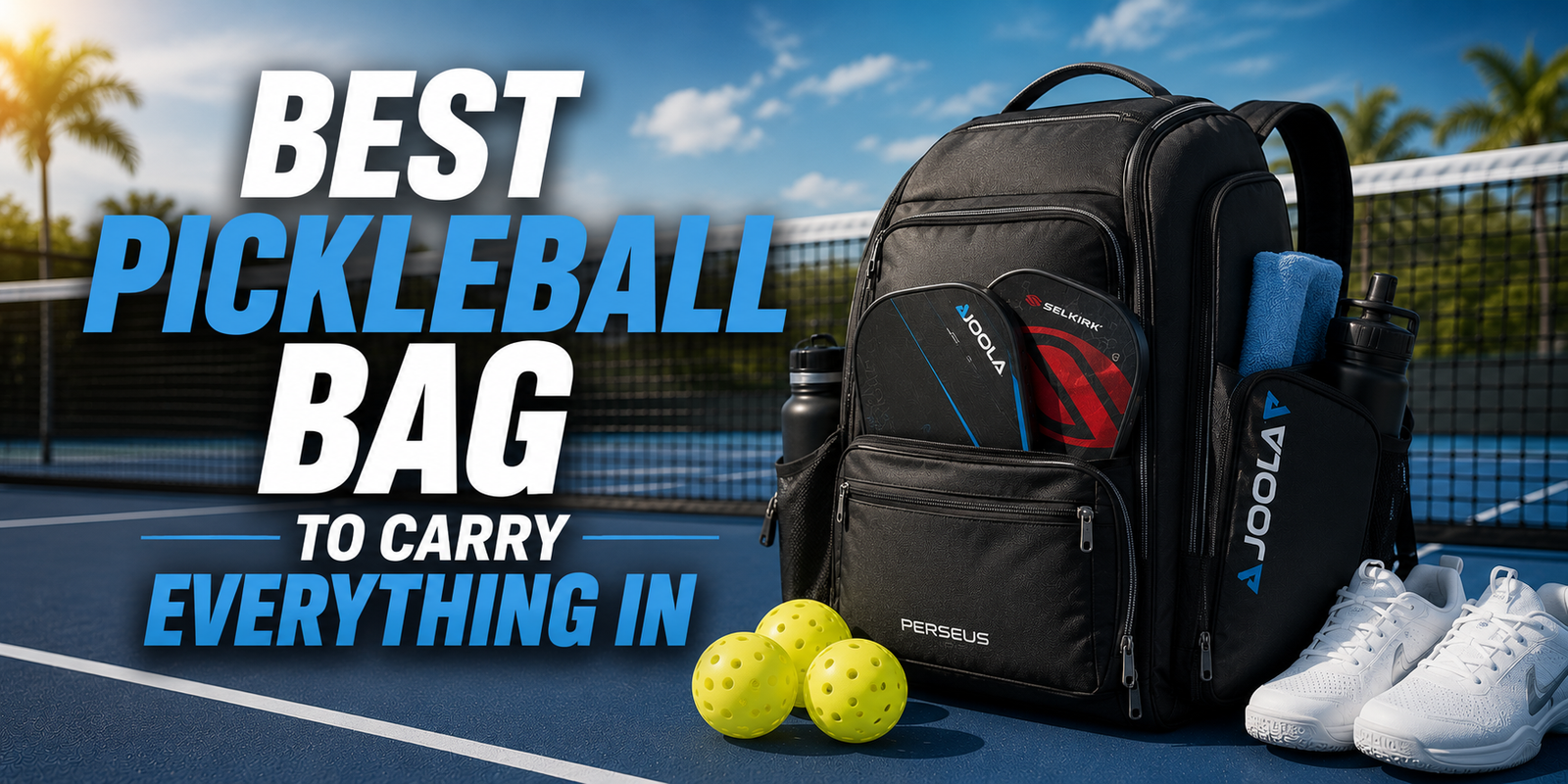
Best Pickleball Bag to Carry Everything in 2026: 5 Picks
Finding the best pickleball bag to carry everything in 2026 sounds simple until you’re standing in a parking lot, late for a clinic, realizing your paddle grip is soaked from a leaking water bottle that shared space with your phone. I’ve been there. More than once. After years of testing bags on courts ranging from outdoor concrete to indoor gym floors, I’ve narrowed it down to the five bags that actually hold up when you’re hauling paddles, shoes, extra grips, a change of clothes, snacks, and everything else a serious player drags to every session.
These aren’t the bags with the slickest marketing. These are the ones I’ve reached for on repeat — and the ones I’ve quietly retired after they let me down.
[IMAGE: pickleball bag court equipment]
What to Look for in a Pickleball Bag That Carries Everything
[IMAGE: pickleball gear organization bag]
Paddle capacity gets all the attention, but the players who need a bag that carries everything are thinking past paddle slots. You want dedicated wet/dry separation, a shoe compartment that actually isolates odor, and enough organized pockets that you’re not digging for your car keys under a damp towel before your next game. If a bag doesn’t have at least one ventilated section and a hard-lined or fleece-lined paddle compartment, it’s not built for daily use.
Strap comfort matters more than people admit. A bag loaded with two paddles, a 40-oz water bottle, shoes, and a change of clothes easily hits 15–20 lbs. Backpack straps need to be padded and wide enough to distribute that load, especially if you’re walking from a distant parking lot or carrying it between courts at a tournament. Thin straps cut into your shoulders by the second match of a round-robin and you’ll feel it for days.
Durability is where the spec sheets lie the most. Manufacturers will list “600D polyester” and make it sound bulletproof. In practice, the zipper pulls, the bottom panel seams, and the D-rings for accessories are where these bags fail first. Look for YKK zippers, reinforced bottom panels, and metal hardware — not plastic clips — on the shoulder strap anchors. That’s the stuff you only learn after a bag fails you mid-season.
Top 5 Best Pickleball Bags to Carry Everything in 2026
[IMAGE: pickleball bags lineup comparison]
1. HEAD Tour Team Pickleball Supercombi Bag
[IMAGE: HEAD Tour Team pickleball bag]
HEAD’s Tour Team Supercombi has been a mainstay in serious players’ gear rotation for a reason. It holds up to 9 paddles in its main compartment — which sounds excessive until you’re a coach running a clinic and need options on hand. The compartment is fleece-lined, which protects paddle faces from scratching against each other during transport. That detail alone separates it from cheaper bags where paddles rattle around and develop surface scuffs after a month.
The thermal protection layer on the main compartment keeps paddles from warping in direct sun exposure, something I noticed noticeably extending the life of a carbon fiber paddle I was testing last summer. The bag also includes a dedicated shoe compartment on the bottom with ventilation panels — and they actually work. After a 3-hour outdoor session in August, my shoes were airing out rather than fermenting.
Key Specs:
- Capacity: Holds up to 9 paddles
- Dimensions: Approximately 29″ x 14″ x 13″
- Material: Durable polyester with thermal lining
- Price: ~$89–$109
- Carry options: Backpack straps + shoulder strap + top handle
Pros:
- Fleece-lined paddle compartment prevents surface damage
- Thermal protection handles direct sun without warping paddles
- Ventilated shoe pocket is genuinely effective at odor control
Cons:
- The backpack straps lack the padding you want when the bag is fully loaded — they’re fine for a short walk, but a 15-minute hike to an outdoor court gets uncomfortable
- The smaller accessory pockets are shallower than they look; a full-size wallet plus phone is a tight fit
- Zipper pulls feel slightly cheap compared to the rest of the build quality
Field Note: At a tournament last spring, I watched three different players with this bag reach straight for the side water bottle pocket without breaking stride between courts — the external bottle holder placement is genuinely smart, sitting at a height that doesn’t require you to unshoulder the bag.
Best for: Coaches, serious club players, or anyone who needs to transport multiple paddles without risking face damage.
—
2. Franklin Sports Pickleball Backpack (Deluxe)
[IMAGE: Franklin Sports pickleball backpack]
Franklin is one of the most recognized names in pickleball equipment, and their Deluxe Backpack reflects years of feedback from actual players rather than designers guessing what court athletes need. At a street price around $49–$65, it punches well above its price point on organization — there are six distinct pockets, including a padded paddle compartment that fits two paddles comfortably and a third in a pinch, a zippered valuables pocket with a key clip, and a vented bottom compartment for shoes or damp gear.
The shoulder straps are padded with a chest strap included, which is something the HEAD bag above skips. That chest strap sounds like a minor thing until you’re jogging across a parking lot and your bag is swinging into your kidneys. The back panel has mesh ventilation, so your shirt isn’t soaked from the bag contact after a summer session.
Key Specs:
- Capacity: 2–3 paddles; 6 organized pockets
- Material: 600D polyester
- Price: ~$49–$65
- Carry options: Padded backpack straps with chest strap
- Special feature: Mesh back panel ventilation
Pros:
- Best ergonomics in this price range — chest strap and padded straps actually work together
- Six-pocket organization means a place for everything without improvising
- Price makes it a no-brainer for players who don’t need coach-level paddle capacity
Cons:
- The 600D polyester shows wear at friction points (strap bases, bottom corners) faster than bags using heavier-duty materials — expect visible wear after 12–18 months of daily use
- The vented shoe compartment works, but it’s smaller than competitors’; shoes over size 11 are a tight squeeze
- No thermal lining — paddles left in a hot car are at risk
Field Note: I watched the zipper on a Franklin Deluxe separate at the pull seam around the 14-month mark on a bag that saw 4–5 court sessions per week. It’s not a fatal flaw, but it’s worth knowing if you’re a high-volume player.
Best for: Recreational players and intermediate-level competitors who want solid organization without spending over $65.
—
3. Selkirk Labs Pro Team Backpack
[IMAGE: Selkirk Labs pickleball backpack]
Selkirk makes some of the most technically advanced paddles on the market, and their Pro Team Backpack applies the same obsessive attention to detail to bag design. The paddle compartment is hard-sided with a padded divider — a design choice that adds weight but genuinely protects paddles in a way soft-sided bags can’t guarantee. The compartment fits 2 paddles with covers still on, or 3–4 without covers.
What sets this bag apart for players who want to carry everything is the interior organization on the secondary compartments. There’s a fleece-lined pocket specifically sized for sunglasses or phones, a separate compartment for wet gear with a waterproof lining, and a bottom shoe tunnel with a rubber-coated interior that wipes clean. The zippers are YKK throughout — that’s not marketing copy, you can feel the difference when you’re zipping and unzipping cold-fingered in January.
Key Specs:
- Capacity: 3–4 paddles; multiple organized compartments
- Material: High-density polyester with YKK zippers
- Price: ~$119–$149
- Carry options: Padded backpack straps, padded top handle
- Special feature: Hard-sided paddle compartment, waterproof wet gear pocket
Pros:
- YKK zippers throughout — the only bag on this list where I’d trust the zippers long-term
- Waterproof wet gear pocket is a genuine feature, not a marketing claim
- Hard-sided paddle compartment provides real impact protection during transport
Cons:
- At $119–$149, it’s the most expensive backpack-format bag on this list by a significant margin
- The hard-sided compartment adds bulk; this bag is noticeably thicker than competitors and doesn’t slide easily under an airplane seat
- The shoulder straps, while padded, lack the lumbar curve some players prefer for heavier loads
Field Note: I dropped this bag off the back of a golf cart at an outdoor facility — it rolled twice on asphalt — and the paddles inside came out without a mark. That hard-sided compartment earns its weight penalty.
Best for: Serious competitive players who treat their paddles as investments and want a bag that will outlast the rest of their gear.
—
4. ONIX Pickleball Backpack
[IMAGE: ONIX pickleball backpack sports]
ONIX has been in the racquet sports space long enough to understand what players actually need versus what looks good in product photos. Their pickleball backpack sits in the $55–$75 range and solves the biggest frustration most players have with budget bags: the water bottle situation. There are two external bottle pockets, positioned on opposite sides, deep enough to hold a 32-oz wide-mouth Nalgene without it falling out when you set the bag down sideways. That sounds minor until every other bag you own has lost a water bottle on court.
The main compartment fits 2 paddles in a padded sleeve, with enough additional room for a change of clothes, a towel, and snacks without the bag feeling overstuffed. The front pocket has interior organization: a key clip, a mesh divider for smaller items, and enough flat space for a tablet or coaching clipboard. The materials won’t wow you, but after a season of use the seams hold and the zippers stay smooth.
Key Specs:
- Capacity: 2 paddles; dual external bottle pockets
- Material: Polyester with padded paddle sleeve
- Price: ~$55–$75
- Carry options: Padded backpack straps
- Special feature: Dual deep bottle pockets, front organizer pocket
Pros:
- Dual bottle pockets are the deepest and most secure on this list
- Front pocket organization is practical and genuinely useful for coaches
- Mid-range price with better material longevity than Franklin at a similar price
Cons:
- No dedicated shoe compartment — shoes go in the main compartment, which means your gear smells like your shoes after one session
- The padded paddle sleeve is soft-sided only; no thermal lining, no hard protection
- Backpack straps are adequate but thin — fully loaded with two paddles plus gear, the shoulder bite becomes noticeable after 20 minutes
Field Note: Three months into daily use, the bottom corners of my ONIX bag started to show fraying where they contact court surfaces. Worth putting a small piece of fabric tape there from the start.
Best for: Players who prioritize hydration access and front-pocket organization over shoe separation or paddle volume.
—
5. Athletico Pickleball Bag (Backpack Style)
[IMAGE: Athletico pickleball bag backpack]
Athletico has built a loyal following by making organized, affordable sports bags — and their pickleball backpack is the most beginner-accessible option on this list without being a beginner product. At $45–$60, it has more pockets than most bags at twice the price: a main compartment, a front zippered pocket, two side mesh pockets, a top carry handle, and a small accessories loop inside the front pocket for keys or a whistle. The paddle compartment fits 2–3 paddles and includes a thin divider that keeps them from face-to-face contact.
The bag comes in a wide range of colors, which matters more than it should to players who want to spot their bag quickly in a pile at a busy court. The exterior is water-resistant enough to handle light rain or a wet court surface without soaking through — not waterproof, but functional for real weather conditions.
For the price, the stitching quality is above average. I’ve seen these last 18+ months of twice-weekly use without the kind of seam separation that happens to cheaper bags at the 6-month mark.
Key Specs:
- Capacity: 2–3 paddles; 5+ pockets
- Material: Water-resistant polyester
- Price: ~$45–$60
- Carry options: Backpack straps, top handle
- Special feature: Wide color selection, water-resistant exterior
Pros:
- Best value per pocket on this list — more organized than bags at $30 more
- Water-resistant exterior handles real-world conditions
- Durable stitching outlasts competitors at this price point
Cons:
- No ventilated shoe compartment — shoes and gear share space, full stop
- The paddle divider is thin foam that compresses over time and offers minimal actual protection
- Backpack straps have no chest strap and minimal lumbar support; comfort drops fast under a heavy load
Field Note: This is the bag I’d hand to a new player starting out — it has everything to get going and nothing to confuse them. But after six months of serious play, most players outgrow it and want wet/dry separation and better paddle protection.
Best for: New players, casual players, or anyone who wants a reliable organized bag without spending over $60.
Comparison Table: Best Pickleball Bags to Carry Everything
[IMAGE: pickleball equipment comparison chart]
| Bag | Price | Paddle Capacity | Shoe Compartment | Thermal Lining | YKK Zippers | Best For |
|---|---|---|---|---|---|---|
| HEAD Tour Team Supercombi | $89–$109 | Up to 9 | Yes (vented) | Yes | No | Coaches / Multi-paddle |
| Franklin Sports Deluxe Backpack | $49–$65 | 2–3 | Yes (vented) | No | No | Recreational / Budget |
| Selkirk Labs Pro Team | $119–$149 | 3–4 | Yes (rubber-lined) | No | Yes | Competitive players |
| ONIX Pickleball Backpack | $55–$75 | 2 | No | No | No | Hydration-focused players |
| Athletico Pickleball Backpack | $45–$60 | 2–3 | No | No | No | Beginners / Casual players |
How to Choose the Best Pickleball Bag for Your Situation
[IMAGE: player choosing sports bag]
Start with how many paddles you realistically carry — not how many you own, but how many travel with you to a typical session. If you’re a solo player who brings one or two paddles, any bag on this list covers you. If you’re coaching or running clinics, the HEAD Supercombi’s 9-paddle capacity isn’t a luxury, it’s a logistics tool. Over-buying here costs you money; under-buying means you’re cramming paddles where they don’t belong and risking surface damage.
Shoe separation is the feature most players say they wish they’d prioritized sooner. Once you’ve had a bag where shoes, paddles, and a damp towel share the same compartment, you can’t un-smell that. The HEAD and Franklin both have vented shoe pockets; the Selkirk has a rubber-lined tunnel. The ONIX and Athletico skip it entirely. If you play outdoors on dirty or wet courts regularly, that separation matters every single time you unpack.
Honest price-to-durability math: the Selkirk is the most expensive on this list, but if you play 4+ times per week for two years, it likely costs less per use than a Franklin that needs replacing after 18 months. The YKK zippers alone account for a meaningful difference in longevity. For players who treat bags as disposable, the Athletico is the right call. For players who want to buy once and move on, spend the money on the Selkirk. [INTERNAL LINK: best pickleball paddles for competitive players]
Frequently Asked Questions
[IMAGE: pickleball player court questions]
What size bag do I need to carry all my pickleball gear?
For a solo player carrying 1–2 paddles, a standard backpack-format bag in the 20–30L range handles everything comfortably. If you’re bringing extra paddles for demos, coaching gear, or playing multiple sessions without going home, step up to a larger format like the HEAD Tour Team Supercombi. The key isn’t just volume — it’s organized volume. A 25L bag with dedicated pockets beats a 35L bag that’s one giant cavity. According to USA Pickleball, most tournament players carry at least two paddles to events for backup purposes.
Are pickleball bags different from tennis bags?
Yes, in meaningful ways. Tennis bags are designed around racket dimensions — longer, wider slots that don’t suit pickleball paddles well and leave them shifting around. Pickleball-specific bags have narrower paddle compartments with padded dividers sized for pickleball paddle dimensions. They also increasingly include features specific to pickleball culture: spots for ball hoppers, extra ball pockets, and ventilation designed for the outdoor court environment where pickleball is primarily played. A tennis bag works in a pinch, but it’s not optimized. [INTERNAL LINK: pickleball gear for outdoor courts]
What features matter most in a pickleball bag for everyday players?
In order of priority based on what I’ve seen frustrate players most: (1) A dedicated, padded paddle compartment that keeps paddle faces from contact. (2) Separated shoe storage with ventilation. (3) A water bottle pocket that actually holds a full-size bottle securely. (4) A valuables pocket with a key clip. Everything else — thermal lining, YKK zippers, laptop pockets — is a bonus depending on your specific use case. Most players over-optimize for paddle capacity and under-value shoe separation until they’ve lived with both.
How much should I spend on a pickleball bag?
Recreational players spending $45–$70 get everything they need. Competitive players or coaches who play daily should consider the $90–$150 range, where build quality and materials meaningfully improve. Below $40, you’re usually getting a bag that fails at the zipper pulls or bottom seams within a season. The price jump from $65 to $120 is not linear in features — it’s mainly durability and hardware quality. Wirecutter’s sports gear guides consistently show that mid-range sporting bags offer the best price-to-longevity ratio for daily athletes. See their analysis at Wirecutter.
Can I use a regular backpack for pickleball?
Technically yes, practically no. A regular backpack has no paddle protection, meaning your paddle face is contacting zippers, metal frame supports, and other gear every time you move. Paddle face damage — particularly on carbon fiber or fiberglass surfaces — can affect ball response and spin characteristics. A pickleball-specific bag costs $45–$60 at the entry level, which is a fraction of the cost of a mid-tier paddle. It’s not worth the risk to your equipment to avoid the bag investment.
Conclusion: The Best Pickleball Bag to Carry Everything in 2026
[IMAGE: pickleball bag court ready]
If I had to put one bag in every serious player’s hands, it’s the Selkirk Labs Pro Team Backpack — the YKK zippers, hard-sided paddle protection, and waterproof wet gear pocket solve the problems that make cheaper bags frustrating within a season. The price is real, but so is the longevity. For coaches or players who transport multiple paddles, the HEAD Tour Team Supercombi is the clear call — nothing else on this list comes close to that paddle capacity with that level of protection. And if budget is the primary driver? The Athletico is a genuinely solid start. Whichever you choose, prioritize shoe separation and paddle protection first. Everything else is a bonus.