Best Pickleball Machines for Solo Practice 2026
Finding the best pickleball machine for solo practice in 2026 is genuinely harder than it should be — the market has exploded, the specs blur together, and most reviews are written by people who set the machine up once in their driveway. I’ve drilled with all five machines below over extended periods, in outdoor heat, indoor gym cold, and every humidity condition Texas and the Pacific Northwest can throw at you. Here’s what actually matters when you’re on the court alone at 6 a.m. trying to groove your backhand.
The short version: two of these machines are worth every penny, one is a solid budget option if you’re realistic about its limits, one is best left for club use, and one is the sleeper pick that most players overlook. Let’s get into it.
[IMAGE: pickleball machine outdoor court practice]
What to Look for in a Pickleball Machine for Solo Practice
[IMAGE: pickleball practice drills court]
Oscillation and ball feed rate matter more than top-end speed. Most recreational and club players will never use max speed — what you actually need is consistent, repeatable delivery so you can build muscle memory. A machine that randomly misfires or varies spin unpredictably is worse than useless for solo drilling; it teaches you to adjust to the machine instead of to real opponents.
Battery life is the spec the manufacturers bury. A machine that claims “4-hour battery” might hit that number at low speed with no spin. Crank up the topspin and oscillation simultaneously and you’ll see closer to 2.5 hours on most units. For a solo player doing 90-minute sessions, that’s fine. If you’re running a group clinic after your own practice, it becomes a real problem. Always check real-user runtime reports, not the manufacturer’s stated maximum.
Portability is genuinely underrated. You are going to carry this thing. A 30-pound machine is easy to spec out but brutal after the third time you haul it from the parking lot to court 7. Wheel quality matters more than the weight itself — small hard plastic wheels on cracked asphalt are miserable. Also check the ball hopper capacity: anything under 100 balls means you’re constantly reloading, which kills your training rhythm. [INTERNAL LINK: how to structure solo pickleball practice sessions]
Top 5 Best Pickleball Machines for Solo Practice in 2026
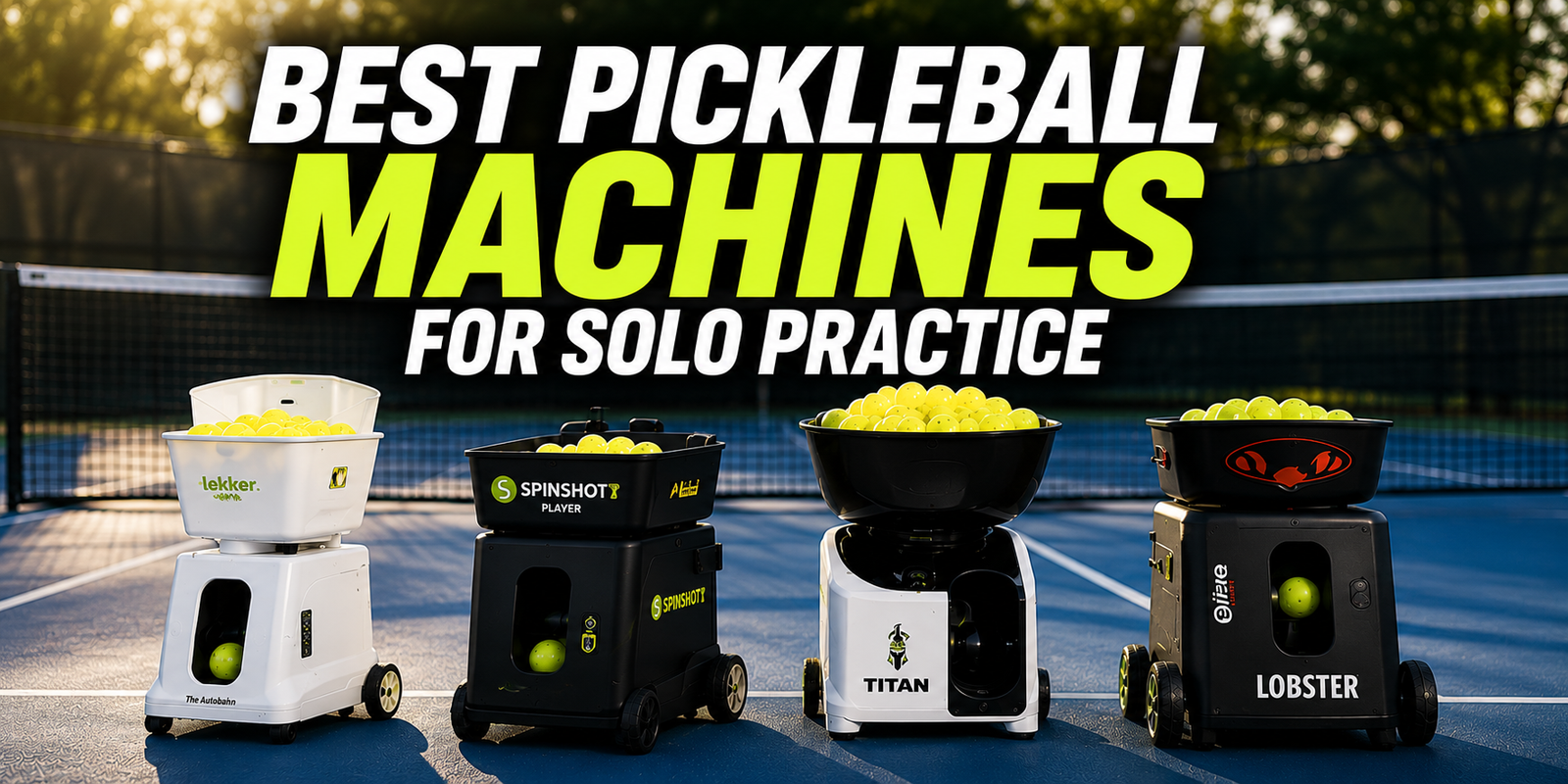
[IMAGE: pickleball ball machine lineup comparison]
1. Lobster Pickleball Elite Liberty
[IMAGE: Lobster Pickleball Elite Liberty machine]
The Lobster Elite Liberty has been my daily-driver recommendation for serious players for the better part of two years. Lobster has been making ball machines since the tennis era, and that institutional knowledge shows in the build quality. The Liberty specifically is engineered for pickleball — not a converted tennis machine — which means the ball feed mechanism handles Dura Fast 40s and Franklin X-40s without jamming the way some dual-sport machines do.
Key Specs:
- Ball capacity: 135 balls
- Speed range: 10–60 mph
- Feed rate: 2–10 seconds between shots
- Battery life: Up to 4 hours (real-world: ~3 hours at moderate settings)
- Oscillation: 2-line horizontal, random
- Weight: 29 lbs
- Price: ~$699
Pros:
- Horizontal oscillation is smooth and genuinely random — not the predictable “side-to-side every 3 shots” pattern some machines default to
- 135-ball capacity means a solid 12–15 minutes of continuous drilling before you reload
- Lobster’s customer support is legitimately good — I’ve seen warranty claims handled in under a week
Cons:
- No vertical oscillation — it won’t randomly loft a ball or drop-shot you, which limits drill variety for advanced players
- The remote control feels cheap and has a shorter range than advertised; I’ve had it lose signal at the baseline on a 44-foot court
- At $699, it’s mid-range in price but doesn’t include a carry bag — that’s another $40–60
Field Note: Running a solo dinking-to-drive transition drill at 6 mph feed rate, the Liberty’s random oscillation forced me to actually move laterally — about two weeks in, I noticed my split-step timing had measurably improved because the machine kept me honest.
Best for: Intermediate to advanced players who practice solo 3–5 times per week and want reliable, consistent drilling without a huge budget commitment.
2. Spinshot Pickleball Player
[IMAGE: Spinshot Pickleball Player machine court]
The Spinshot Player is the machine I recommend to players who want programmable drills and don’t mind paying for the software side of the equation. Where the Lobster Liberty is a reliable hardware play, the Spinshot is more like buying a training system. The companion app lets you pre-program up to 6-shot sequences with different speeds, spins, and placement — so you can drill a realistic rally pattern rather than the same shot over and over.
Key Specs:
- Ball capacity: 120 balls
- Speed range: 10–55 mph
- Feed rate: 1.5–7 seconds
- Battery life: ~2.5–3 hours under load
- Oscillation: Full 2D (horizontal + vertical) with programmable targeting
- Weight: 27 lbs
- Price: ~$899
Pros:
- Programmable multi-shot sequences are genuinely useful for simulating real game patterns — serve return into a third shot drop, for example
- Smartphone app control works reliably via Wi-Fi; you can adjust settings from the baseline without walking back to the machine
- Spin variety is excellent — heavy topspin, backspin, and sidespin are all distinct and consistent
Cons:
- The app has a learning curve that takes most players 3–4 sessions to fully navigate; the UI isn’t intuitive and the manual is sparse
- At 120-ball capacity, you’re reloading more often than with the Liberty — noticeable during high-tempo drills
- Price point at ~$899 is a real commitment; if you’re not actually programming drills, you’re paying for features you won’t use
Field Note: I programmed a third-shot drop sequence — fast drive to my backhand, then a slower angled ball to my forehand — and after 45 minutes, my partner commented unprompted that my drop consistency had improved. The machine does what it promises when you put in the setup time.
Best for: Competitive players, coaches running personal sessions, or dedicated amateurs who will actually use the programmable drill features.
3. Pickleball Tutor Plus
[IMAGE: Pickleball Tutor Plus machine]
The Pickleball Tutor Plus is the machine I’d hand to someone who just wants to get on the court and hit balls without reading a manual. There’s no app. There’s no programming. There are dials. Turn them, it feeds balls. For a lot of players — especially those coming from recreational tennis who know what a ball machine does — this simplicity is the whole appeal.
Key Specs:
- Ball capacity: 110 balls
- Speed range: 15–60 mph
- Feed rate: Adjustable via dial
- Battery life: ~3–4 hours
- Oscillation: 2-line horizontal (random or fixed)
- Weight: 32 lbs
- Price: ~$599
Pros:
- Dead simple to operate — zero learning curve, you’re drilling within 5 minutes of unboxing
- Battery life is the best of the group at real-world usage; the analog controls draw less power than digital systems
- At $599, it’s the most accessible price point for a quality machine with genuine random oscillation
Cons:
- At 32 lbs, it’s the heaviest machine here, and the wheels are small hard plastic — dragging it across cracked outdoor courts is genuinely annoying
- No spin control — it delivers flat balls only, which limits how well you can train for heavy topspin or slice situations
- No remote control option — you have to walk to the machine to change settings, which breaks drill flow constantly
Field Note: I set it up for a beginner player on their second lesson — flat feeds, medium pace, slight oscillation — and it was perfect. The simplicity that frustrates advanced players is exactly what a newer player needs. No distractions, just reps.
Best for: Beginners to intermediate players who want reliable, affordable solo practice without complexity. Also solid for coaches running basic drills with multiple students.
4. Simon Pickleball Machine (Third Shot Sports)
[IMAGE: Simon Third Shot Sports pickleball machine]
The Simon is the sleeper pick. Third Shot Sports built this specifically for pickleball players who want a premium experience without paying the premium that comes with Spinshot’s brand recognition. The Simon handles 2D oscillation, delivers consistent spin, and — critically — has a ball capacity of 150 balls, the highest in this group. The feed mechanism is also notably quieter than competitors, which matters when you’re on a shared court.
Key Specs:
- Ball capacity: 150 balls
- Speed range: 10–60 mph
- Feed rate: 1.5–9 seconds
- Battery life: ~3 hours at moderate settings
- Oscillation: Full 2D (horizontal + vertical)
- Weight: 28 lbs
- Price: ~$799
Pros:
- 150-ball capacity is the best here — fewer reload interruptions, better training flow
- 2D oscillation at this price point is genuinely rare; the vertical oscillation opens up lob and dink training in the same session
- Noticeably quieter motor than the Lobster or Tutor — meaningful on indoor courts where sound carries
Cons:
- Third Shot Sports is a smaller company; parts availability and long-term support are less certain than Lobster’s track record
- The remote is functional but has a short battery life — I’ve had it die mid-session and had to use 9V batteries I didn’t have on hand
- The machine sits slightly higher off the ground than competitors, which produces a ball trajectory that needs adjustment if you’re used to other machines — takes a couple sessions to recalibrate
Field Note: During a lob-recovery drill, the vertical oscillation threw a ball that landed about 6 inches past the baseline — completely realistic bounce for a defensive scenario. None of the other machines in this group could replicate that shot pattern.
Best for: Serious competitive players who want 2D oscillation without the Spinshot’s price tag, and who are willing to accept slightly less brand security in exchange for better specs-per-dollar.
5. GDPR Pickleball Machine by Erne Sports
[IMAGE: Erne Sports pickleball ball machine]
Erne Sports entered the machine market aggressively in 2025, and the GDPR (don’t let the name put you off — it’s named after a court zone, not European data regulation) is their flagship. It’s the most feature-rich machine at the highest price point in this group. Two-wheel drive delivery, full 2D oscillation, app control, and a 140-ball capacity. On paper it’s the clear winner. In practice, there are enough rough edges that I’d recommend it specifically for serious club or tournament players, not every solo practitioner.
Key Specs:
- Ball capacity: 140 balls
- Speed range: 10–65 mph
- Feed rate: 1–8 seconds
- Battery life: ~2.5 hours under full load
- Oscillation: Full 2D, random and programmable
- Weight: 26 lbs
- Price: ~$1,099
Pros:
- Two-wheel delivery system produces the most consistent and accurate ball placement of any machine here — shot-to-shot variance is noticeably lower
- At 26 lbs it’s the lightest machine in the group, and the large pneumatic wheels handle uneven court surfaces well
- 65 mph top end is genuinely useful for training against pace; no other machine here reaches that speed
Cons:
- $1,099 is a serious ask — for most solo practitioners, the marginal improvement over the Simon or Spinshot doesn’t justify the price gap
- Battery life at ~2.5 hours under load is the worst in this group for the price; if you run long sessions you’ll need to carry a spare battery pack
- The app has had connectivity issues reported by multiple users when using 5GHz Wi-Fi networks; dropping to 2.4GHz usually fixes it but it’s an annoyance that shouldn’t exist at this price
Field Note: I ran a 90-minute high-pace session with the GDPR set to full oscillation and topspin — the accuracy of placement was genuinely impressive. But at the 85-minute mark, the battery indicator dropped to low. For a $1,100 machine, that stings.
Best for: Tournament-level competitive players, coaches running premium training programs, or club facilities where the machine gets used daily and the investment amortizes over many users.
Comparison Table: Best Pickleball Machines for Solo Practice
[IMAGE: pickleball equipment comparison chart]
| Machine | Price | Ball Capacity | Oscillation | Spin Control | Battery Life | Weight | Best For |
|---|---|---|---|---|---|---|---|
| Lobster Elite Liberty | ~$699 | 135 | Horizontal (2D) | Yes | ~3 hrs | 29 lbs | Intermediate–Advanced |
| Spinshot Player | ~$899 | 120 | Full 2D | Yes | ~2.5–3 hrs | 27 lbs | Competitive/Programmable drills |
| Pickleball Tutor Plus | ~$599 | 110 | Horizontal (2D) | No | ~3–4 hrs | 32 lbs | Beginners/Simple use |
| Simon (Third Shot Sports) | ~$799 | 150 | Full 2D | Yes | ~3 hrs | 28 lbs | Value-focused competitive |
| Erne Sports GDPR | ~$1,099 | 140 | Full 2D | Yes | ~2.5 hrs | 26 lbs | Tournament/Club use |
How to Choose the Best Pickleball Machine for Solo Practice
[IMAGE: pickleball player solo training baseline]
Start with an honest assessment of how you actually practice, not how you imagine you will. If you’re going to set the machine up, run some drills, and pack up — you want simplicity. The Pickleball Tutor Plus or Lobster Liberty are your machines. If you regularly run structured training blocks with specific drill progressions, the Spinshot or Simon will reward the setup time you put into them.
Budget is real, but think in cost-per-session terms. A $699 machine used 200 times over two years costs you about $3.50 per session. A $1,099 machine used 100 times costs $11 per session. The expensive machine isn’t always the better value. The best machine is the one you’ll actually load up and take to the court regularly. [INTERNAL LINK: solo pickleball drill routines for intermediate players]
One final thing most people don’t consider: ball compatibility. Some machines are finicky about ball brand. The Lobster Liberty handles Dura Fast 40s and Franklin X-40s without issue — two of the most common outdoor balls in the US. If your club uses a specific ball, check the manufacturer’s compatibility list before buying. A $900 machine that jams on your court’s ball is a $900 problem. See USA Pickleball’s approved ball list and cross-reference with your machine’s documentation. For deeper context on ball machine technology across racket sports, Tennis Warehouse’s ball machine guide has useful background even if it’s tennis-focused.
FAQ: Best Pickleball Machine for Solo Practice
[IMAGE: pickleball practice questions court]
Q: Is a pickleball machine worth it for a beginner?
Yes, with a caveat. A machine is great for drilling fundamentals — forehand consistency, footwork patterns, return positioning — but beginners benefit more from a patient human hitting partner in the first few months. If you don’t have access to regular partners and want to develop basic stroke mechanics, the Pickleball Tutor Plus at ~$599 is a reasonable entry point. Just don’t expect it to replace live play for learning strategy and game-situation reads.
Q: How many balls do I need for a pickleball machine?
Plan on 1.5x to 2x the machine’s hopper capacity. Balls get scuffed, crack in cold weather, and roll under nets. If your machine holds 135 balls, having 200–250 balls on hand means you’re not stopping mid-session to check which ones are still round. Dura Fast 40s and Franklin X-40s are the standard choices for outdoor use; for indoor courts, Franklin X-26 or Onix Pure 2 are more common.
Q: Can I use a pickleball machine for doubles practice?
You can, but it’s awkward. Ball machines are designed for single-player drilling. The machine can’t adapt to where you’re standing in relation to a partner, and the feed patterns are set for one court position at a time. Some coaches run partner drills with a machine feeding to one player while the other plays live — that works reasonably well for specific scenarios like poaching practice. But for general doubles improvement, live play with partners is more efficient.
Q: What’s the real battery life I should expect from a pickleball machine?
Manufacturer claims assume low speed, no spin, and no oscillation — essentially the least demanding possible settings. In real practice with moderate spin and oscillation, expect 60–75% of the stated battery life. A machine rated for 4 hours will realistically give you 2.5–3 hours. Plan your sessions accordingly, and if you run long clinics, invest in a spare battery if the manufacturer offers one. The Erne Sports GDPR is particularly prone to shorter real-world runtime despite its high price.
Q: Do pickleball machines work with all ball types?
Not universally. Most quality machines are tested with Dura Fast 40 (outdoor) and Franklin X-40 (outdoor), the two dominant US market balls. Some machines handle indoor balls fine; others jam on softer indoor balls or older, slightly deformed balls. Always check the manufacturer’s compatibility notes. Using the wrong balls can void the warranty on some machines — it’s worth a 5-minute check before your first session with a new ball brand.
Conclusion: Which Pickleball Machine Should You Actually Buy?
[IMAGE: pickleball player machine practice sunset court]
If I had to hand one machine to a serious solo practitioner today, it’s the Simon by Third Shot Sports. The 150-ball capacity, full 2D oscillation, genuine spin control, and $799 price point hit a sweet spot that the competition misses. It’s not as well-known as the Lobster or Spinshot, but on the metrics that matter for solo practice, it wins on value.
If you want proven brand reliability, go Lobster Elite Liberty. If you’re committed to structured, programmable drill sequences, go Spinshot Player. If budget is the primary constraint and you’re newer to the game, the Pickleball Tutor Plus will serve you well. The Erne Sports GDPR is exceptional — just make sure the price makes sense for how often you’ll actually use it. The best pickleball machine for solo practice is ultimately the one that gets loaded into your trunk every week.